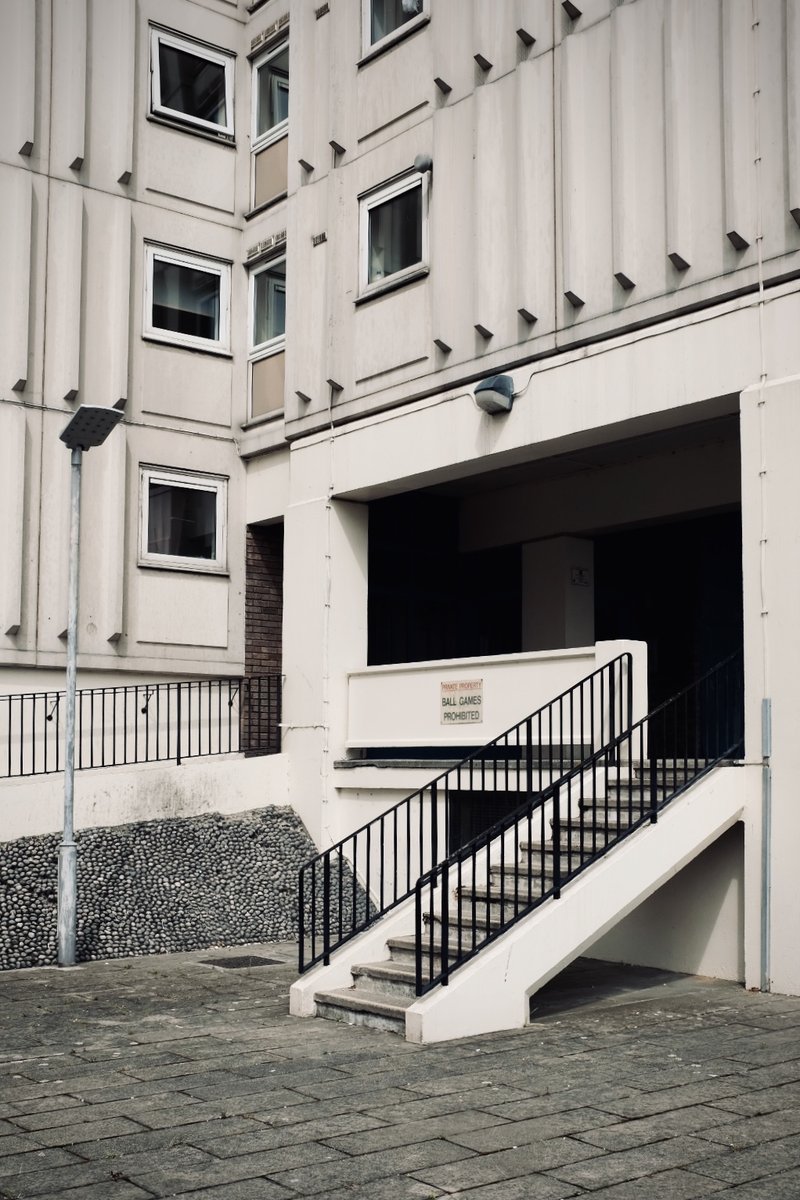
There's a sign on the side of Blackdown Flats in Southend that reads BALL GAMES PROHIBITED.
It's a small white sign on a beige wall, bolted into the brickwork next to the staircase. You wouldn't notice it unless you were looking. We've been looking.
Blackdown Flats were built in the late 1960s, part of the last great wave of post-war public housing in Britain. Concrete and brick, balconies and stairwells, four storeys high, a generous shared space at the front. The architecture is honest. The bones of it are good. It was designed for families with kids, and the space around it was designed to absorb everything those families would need to do outside their front doors.
Including, you'd think, kicking a ball about.
What changed
What changed wasn't the architecture. The architecture is still there. The space at the front of Blackdown is the same space it was in 1968. What changed is what we think space is for.
Sometime between then and now, a decision was made — not a single decision, more a slow accumulation of decisions across decades — that the shared space at the front of a block of flats wasn't really for anything. It became a thing to keep clean, keep clear, keep insurance-friendly. The kids who would have used it became a liability. The ball that would have been kicked became a window-shaped risk. The noise became a complaint.
So we put up a sign.
There are thousands of these signs across Britain now. No ball games. No skating. No cycling. No loitering. No music. No fires. No tents. No drinking. No dogs. No bikes against this railing. CCTV in operation. Each one of them, individually, has a reason. Cumulatively, they describe a country that has slowly stopped believing public space is for public use.
The kids who would have played in front of Blackdown are still around. They just don't play there. They play indoors, or they don't play at all, or they go somewhere they're not allowed to and get moved on by someone. The space sits empty. The sign does its job.
What the sign doesn't say
The sign at Blackdown says BALL GAMES PROHIBITED.
It doesn't say where the kids should go instead.
That's the bit that's missing. If the answer to "don't play here" was "play over there", the sign would be fine — a small piece of co-ordination, a polite request. But the answer to "don't play here" is nothing. There is no over there. The grass strip got fenced off. The car park got barriers. The recreation ground got locked at dusk. The bit of waste ground behind the parade became a private car park. The bowling green became a development site.
The signs went up. The places to go didn't.
That's the contradiction at the heart of the last thirty years of British public space. We didn't make a deliberate decision to take away the room kids needed. We just slowly closed gates, fenced edges, posted signs, and assumed someone else would open something somewhere. Nobody did. We've written about what the town has lost elsewhere. This is the bit you can see from the pavement.
What this has to do with Field.
A piece of ground that makes room for whatever turns up.
We've used that line a few times now, across these notes. It comes from a memory of an actual field, in 90s Dagenham, where the things you wanted to do as a kid were broadly tolerated because the ground was there and nobody had got round to telling you not to.
Field. is being built, in part, as a reply to the BALL GAMES PROHIBITED sign at Blackdown. Not in a hostile way — the sign isn't really the enemy; it's a symptom — but as a small, stubborn counter-example. A room where the answer is yes. Yes you can skate here. Yes you can put your music on. Yes you can sit on the floor. Yes the kids can run around. Yes the toddler can have a tantrum. Yes the older lads can hang out without buying anything. Yes the artist can take the wall for the afternoon. Yes the room will be different tomorrow.
There's a version of British public life where every public room has slowly become a no. We've all felt it. The pub that doesn't really want kids. The café that puts the WiFi on a timer. The library that closes at five. The leisure centre that needs a membership and a booking.
Field. is a small attempt at the opposite. A room shaped like a yes.
We saw the sign. We see what it's saying. We see what's missing on the other side of it. We're building the other side.
We'll see you there.